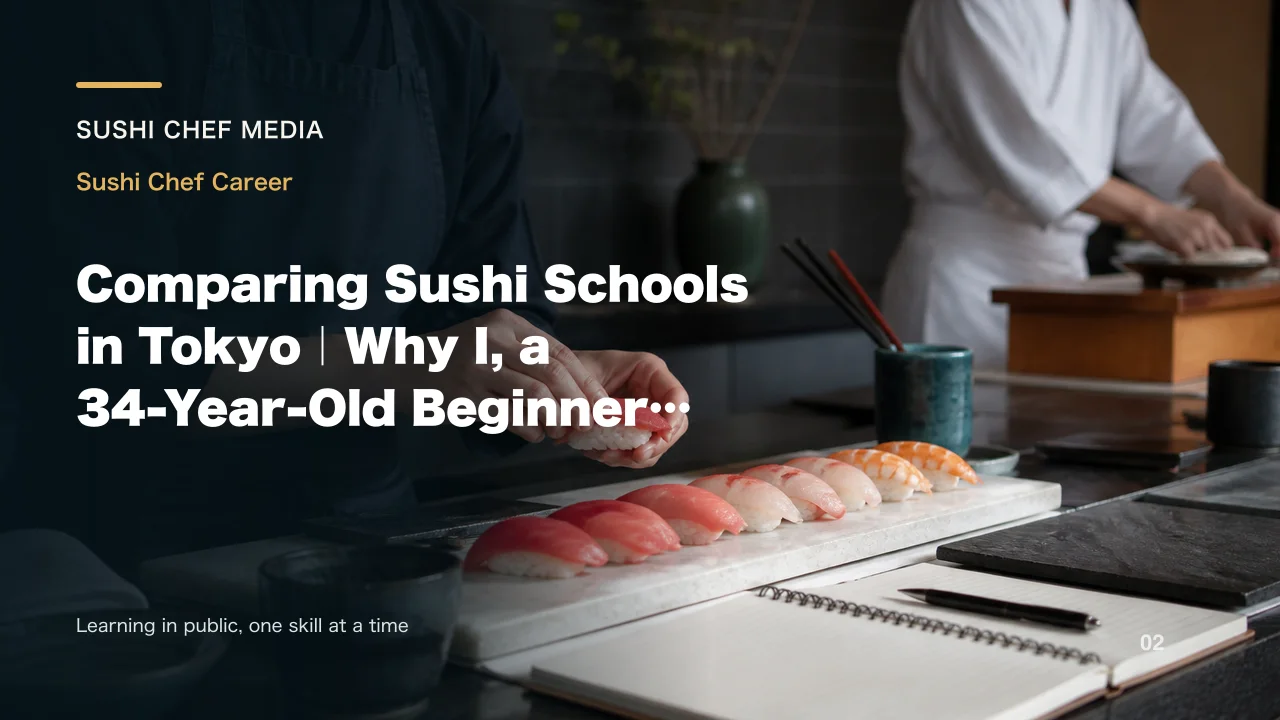
If you want to become a sushi chef in Tokyo, which school should you choose?
There are schools offering short-term intensive courses lasting from one month, half-year courses that build on-site experience and practice, and specialized vocational schools with two-year programs aiming for cooking licenses.
To sum up first: if you want to learn the basics of sushi as quickly as possible, choose a 1–2 month course; if you are considering overseas employment or job change, opt for 3–6 months; and if you want to obtain a cooking license and learn about Japanese cuisine overall, select a two-year program.
Since I was almost a complete beginner aiming to become a sushi chef, I decided to enroll in the six-month course at Tokyo Sushi Academy.
This article organizes a comparison based on official information from schools and explains why I chose the six-month course.
| School / Academy | Main Duration | Tuition Estimate | Suitable For |
|---|---|---|---|
| Tokyo Sushi Academy | 2 months, 6 months, 1 year | ¥968,000–¥1,485,000 | Those considering career change, overseas employment, or gaining practical site experience |
| Sushi College Tokyo | 1 month, 3 months on weekends | ¥319,000–¥473,000 | Those who want small classes and hands-on practice at low cost |
| Tokyo Sushi School | 1 month, 3 months | ¥495,000 | Those wanting to focus on sushi basics intensively in a short time |
| Tokyo Sushi Chef Training Academy | About 2 months | ¥550,000 | Those who value training in a Ginza store environment and job support |
| Insyoku-jin University | 3 months, approx. 420 hours | ¥968,000 | Those emphasizing class hours and overseas job support |
| GINZA ONODERA Sushi Academy | Ticket system | ¥80,000–¥900,000 | Those who want to study at their own pace while working |
| Japan Sushi Leading Academy | 3 months, 6 months | ¥440,000 | Those wanting to study systematically online |
| Tokyo Sushi and Washoku Culinary Vocational School | 2 years | Check annual info | Those aiming for a cooking license and broad Japanese cuisine education |
Tuition fees and application requirements can change.
Especially check the official pages for entrance fees, knife costs, material and ingredient fees, and any campaigns before applying.
I didn’t choose Tokyo Sushi Academy simply because it is well-known.
I focused on these three points:
- Ability to learn from fish preparation, sushi rice (shari), to nigiri step-by-step starting with no experience
- Half a year gives more repeated practice time than short courses
- Options for domestic job placement, overseas employment, and eventual independence remain open
According to official info, Tokyo Sushi Academy offers two types of six-month courses.
The Weekday Intensive runs two days a week (Thursday and Friday), costs ¥968,000.
The Sushi Chef Training Course meets three days a week (Monday to Wednesday), has a 12-person selection limit, costs ¥1,485,000.
I will update this article with which course I enroll in once I receive the application documents and guidance from the school.
The key point is not the course name but rather “how many days per week you can attend, and how much time you can practice outside classes.”
Tokyo Sushi Academy|Ideal for Half-Year Career Building
Founded in 2002, the academy states on its official site that over 5,800 graduates are active in more than 50 countries.
Courses are divided into: 2-month intensive, 6-month weekday, 1-year weekend, and 6-month sushi chef training course.
Differences in the Half-Year Courses
The Weekday Intensive suits those balancing work or family who want to learn the same content spread over six months.
The Sushi Chef Training Course besides thrice-weekly classes expects students to work at sushi restaurants during off-class days and evenings, designed for those with a stronger desire to become chefs.
This design attracted me greatly.
You learn fish preparation and nigiri at school, work at a sushi site on other days, and then clarify doubts in the next class.
Repeating this cycle allows you not only to earn a certificate but also to test whether you can sustain the work.
Points to Note About Tokyo Sushi Academy
The biggest drawback is that tuition is not cheap.
The Weekday Intensive is ¥968,000, and the sushi chef course is ¥1,485,000.
Also, attending the school alone doesn’t make one a fully competent chef.
Knife speed, reproducibility in preparation, customer service, and decision-making during service must continue to be built on-the-job after graduation.
Sushi College Tokyo|Small Groups and Cost-Conscious
Sushi College Tokyo is characterized by small class sizes, up to 4 students.
Per official info, the 1-month intensive runs weekdays 9 a.m. to 3 p.m., with 3 p.m. to 5 p.m. reserved for self-practice in the classroom.
Tuition is ¥418,000 plus a ¥55,000 admission fee, total ¥473,000.
They also offer a 3-month weekend course, suitable for those continuing work.
Small class size nurtures ease in asking questions and detailed supervision.
As a relatively new school (opened 2025), its long-term alumni network and overseas job track record do not match older institutions.
Tokyo Sushi School|Short-Term Focused on Sushi Basics
Located in Ikebukuro, their main short course is one month, totaling 120 class hours.
They charge ¥66,000 admission and ¥429,000 tuition, totaling ¥495,000.
The curriculum emphasizes basics needed in sushi restaurants: fish preparation, sushi rice, nigiri, rolls, tamago (egg), knife sharpening.
It does not cover other Japanese cuisine like tempura or chawanmushi.
This is reasonable for learners who want to focus only on sushi basics first.
However, real work experience is not attained in one month.
The value of “short-term basic skills” at school and actual on-the-job experience should be considered separately.
Tokyo Sushi Chef Training Academy|Ginza Location and Job Support
Operated by DYM Group, the academy’s official info shows a 2-month course of 16 sessions, limited to 8 students.
Admission fee is ¥150,000 and tuition ¥400,000, totaling ¥550,000.
In partnership with Ginza Sushi Usuke, it offers practical simulation at the store counter, visits to Toyosu Market, cost calculations, procurement, and preparation.
Those valuing Ginza’s authentic environment and DYM’s job placement support may find this attractive.
Note discrepancies between older school pages and company pages in fees and capacity; always confirm the latest details before applying.
Insyoku-jin University|Hours and Overseas Support Emphasized
Their Sushi Meister specialization runs 3 months, about 420 hours.
Located in Ebisu, Tokyo, tuition is ¥968,000, covering fish filleting, nigiri, Japanese cuisine knowledge, and store management; handling about 40 fish species.
With many class hours, it suits students who want more hands-on learning than most short courses.
They also offer working holiday support for Canada employment.
If aiming for overseas work, confirm not only curriculum but also support for English resumes, interviews, visas, and local life.
GINZA ONODERA Sushi Academy|Study While Working with Ticket System
They offer a ticket system where students reserve single lessons.
Prices: 10 lessons ¥80,000; 30 lessons ¥225,000; 50 lessons ¥350,000; 100 lessons ¥550,000; 150 lessons ¥750,000; 200 lessons ¥900,000.
Tickets are valid for six months.
You can attend weekdays or weekends, suitable for those balancing work or who want to customize lessons.
Those preferring a fixed weekly curriculum may prefer short intensive schools.
Japan Sushi Leading Academy|Systematic Learning Online
This school provides mainly online video lessons instead of classroom attendance.
Courses: 3 months, 4 days a week or 6 months, 2 days a week, 40 sessions total, tuition ¥440,000.
Includes an 800-page textbook and utensils worth about ¥100,000.
Convenient for distant learners or those continuing work at home.
However, unlike in-person classes, you don’t receive immediate hands-on corrections.
Ideal for students who can allocate practice time and self-correct using videos.
Tokyo Sushi and Washoku Culinary Vocational School|Two-Year Program for Cooking License
This differs from short-term sushi schools.
It is a two-year program in Japanese cuisine, covering sushi and broader washoku (traditional Japanese cuisine), enabling students to obtain a cooking license.
Recommended for high school graduates pursuing culinary careers or those wanting long-term comprehensive study.
For working adults aiming to change careers, securing two years and tuition is a significant consideration.
How to Choose Based on Your Goal
Want to work at a sushi restaurant as soon as possible
Choose short intensive courses lasting 1–2 months.
Keep in mind, much must still be learned after hiring; think of school as building a foundation to get employed, not finishing training.
Want to switch careers from zero experience and practice skills repeatedly
Select 3–6 month courses.
Compare class hours, practice environment, and availability of work outside classes.
From this angle, I chose Tokyo Sushi Academy’s six-month course.
Want to work as a sushi chef overseas
Verify overseas job availability, graduation certificates, visa support, English interview preparation, and local support.
Don’t decide solely based on claims of “strong overseas employment”; ask about which countries, available jobs, and the extent of support.
Want to study while continuing your current job
Consider weekend courses, evening classes, ticket systems, or online learning.
Assess whether you can sustain attendance including commute over six months.
Want a cooking license and study whole Japanese cuisine
Consider two-year vocational culinary schools rather than short sushi courses.
Additional Expenses Beyond Tuition
Budgeting only for tuition may lead to unexpected costs.
- Knives and sharpening tools
- Transportation and housing costs
- Ingredients for extra practice outside class
- Additional uniform or materials fees
- Job hunting or overseas travel expenses
- Living cost during times of reduced income
Tokyo Sushi Academy includes materials, food, and uniforms in tuition depending on the course, but Japanese knives (wa-bocho) might have to be purchased separately.
Every school differs; request estimates to compare properly.
7 Questions to Ask Before Applying
Use these when contacting schools:
- What is the total current cost?
- Are entrance fees, material fees, ingredient fees, and knife costs included?
- How many days a week and hours per day are classes?
- Is self-practice outside class allowed?
- Which countries and regions do job placement services cover?
- What are the policies on leave, make-up classes, cancellations, and refunds?
- What tools should beginners prepare at the start?
In particular, “How many hours can I handle fish and knives?” cannot be gauged by tuition alone.
What I Will Record After Enrolling
On this blog, I will record not just impressions, but as many concrete numbers as possible:
- Hours practiced
- Number of fish filleted
- Yield rates
- Pieces of sushi rice balls (shari) made
- Corrections from instructors
- What I learned to do compared to before enrollment
The mere fact of “attending school” is difficult to convey meaningfully to readers or potential employers.
At 34, starting from zero, aiming for sushi chef work, it matters more to record how I practiced and improved than to hide age or past.
Summary: Choose a School You Can Stick With Rather Than the Shortest
Tokyo’s sushi schools range from 1-month short courses, 3-month volume-focused, half-year repetition-based, ticket system, to two-year vocational programs.
I chose Tokyo Sushi Academy’s six-month course with overseas employment in mind.
I preferred to spend time repetitively practicing and linking to real work over merely acquiring a certificate soon.
I will update this site with class content, costs, practice amount, and setbacks.
For those starting to aim at becoming sushi chefs, school choice is not the goal.
Decide on your working style six months or a year ahead first, then pick the school that matches that goal—a surest way to avoid regrets.