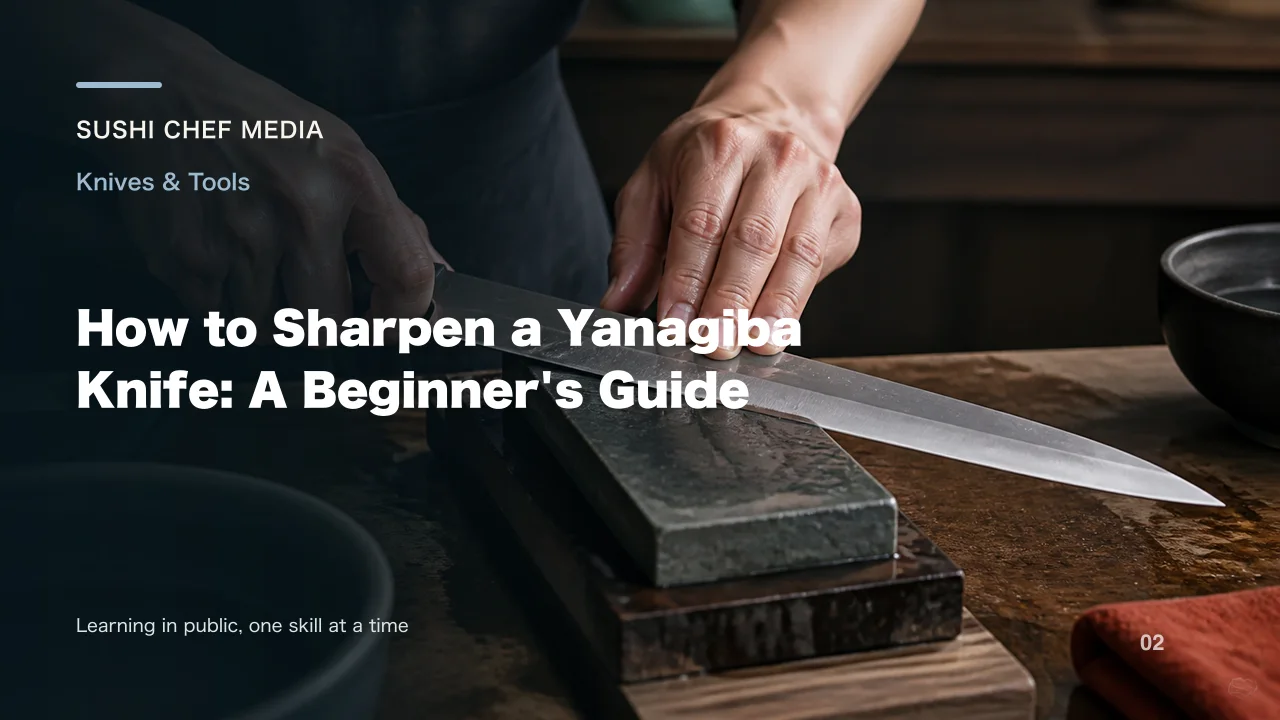
A Yanagiba knife is a single-beveled Japanese knife (片刃, kataba) commonly used in sushi preparation. Unlike double-beveled knives, you should not sharpen the front and back sides the same way, as this can distort the blade’s shape.
This article organizes the basic steps for practicing at home. If it is your first time sharpening, start with a knife that has no chips and practice without heavily grinding down the blade edge.
-
Choosing the Whetstone:
- For everyday maintenance, it’s standard to use a medium grit whetstone and finish with a finer grit stone.
- Only consider a coarse whetstone if you need to fix large chips or reshape the blade. Since coarse stones remove material quickly, it’s safer not to use them initially.
- Soak the whetstone in water according to the product’s instructions, as soaking times vary.
-
Setting the Blade Angle:
- Rather than forcing a specific angle by numbers, prioritize keeping the whetstone flat against the blade’s original bevel.
- Place the whetstone on a non-slip base and support the tip of the knife with your hand opposite to the one holding the handle.
-
Order of Sharpening:
- Sharpen the Front (Beveled Side): Lightly move the beveled side from heel to tip, keeping the same surface contact with the whetstone.
- Check for Burr: When a fine burr (かえり, kaeri) forms on the backside edge line, stop sharpening the front.
- Refine the Back (Flat Side): Lay the back almost flat on the stone and lightly pass it a few times to remove the burr. Do not sharpen this side with the same force or number of strokes as the front.
- Finishing: If needed, repeat the process with a finer whetstone. Lighter pressure at this stage helps achieve a cleaner edge.
-
Checking Burr:
- After sharpening, confirm there is no burr or fine edge wire left.
- Do not check burrs by running your fingers along the blade. Instead, use paper or unwanted food items without bringing your hands close to the edge.
3. Finishing and Storage
-
Finishing:
- Wash the knife with water after sharpening to remove slurry and water.
- Dry the knife thoroughly with a clean cloth.
-
Storage:
- Store the knife in a dry place with low humidity.
- Using blade covers helps protect the edge from deterioration.
4. Common Mistakes and Cautions
-
Over-sharpening:
- Excessive sharpening thins the edge, making it prone to chipping.
- Sharpen gradually while periodically checking the blade condition.
-
Sharpening the Back Like a Double-beveled Knife:
- Sharpening the back like a double bevel can ruin the single-bevel shape of the Yanagiba.
- Consider the back as only for burr removal; consult a professional if there are unusual chips or warping.
Summary
The key to sharpening a Yanagiba knife is preserving the front bevel surface without distortion and avoiding over-sharpening the back. Start with light pressure checking for burrs frequently, and leave chip repairs or reshaping to specialists to reduce errors.
Personal Impressions Using a Whetstone
Actually using a whetstone was more enjoyable than expected. After sharpening, the knife was noticeably easier to use, and I felt more focused when cutting fish.
Edge sharpness varies depending on the knife condition and sharpening technique. These impressions are based on my own conditions, so please practice without applying excessive force to avoid damaging the edge.
Reference Articles
Next Steps
Next time, I will record the condition of the cut edges before and after sharpening, the state of the blade edge, and the sharpening time.